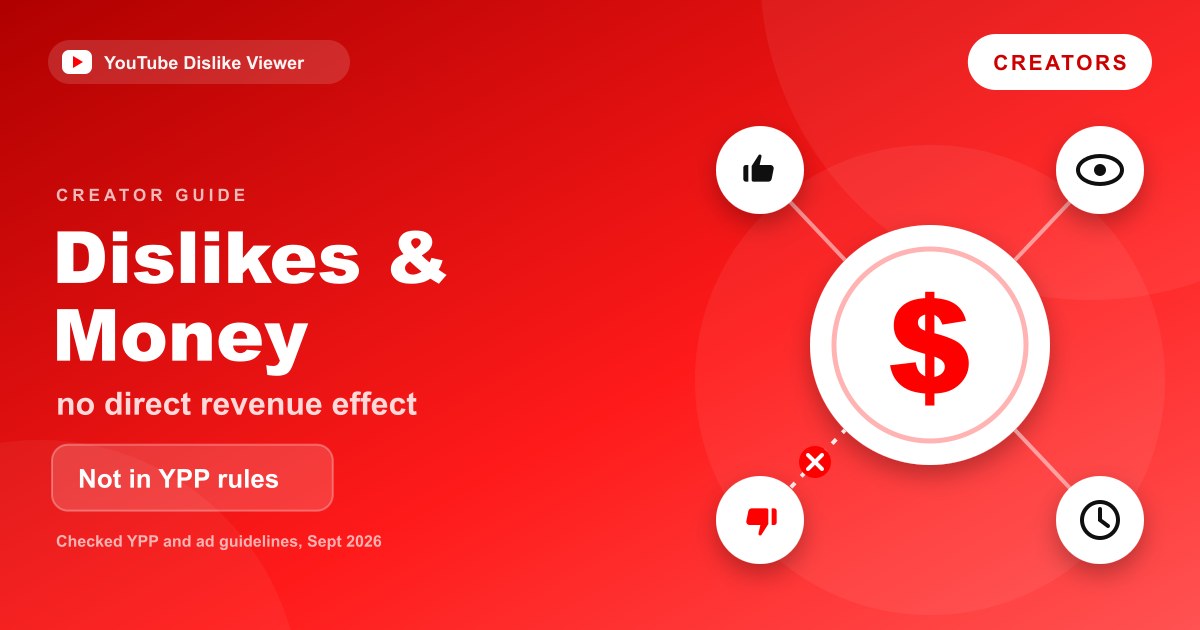
Dislikes don’t directly affect monetization on YouTube. None of YouTube’s monetization documents, including the YouTube Partner Program eligibility rules, the channel monetization policies and the advertiser-friendly content guidelines, mentions dislikes as a factor, and YouTube doesn’t document any rule that removes ad revenue because a video was disliked. Revenue follows eligible views, the ads shown on them and whether the content is suitable for advertisers.
Indirect effects are a different matter. YouTube says it uses a viewer’s dislikes to avoid recommending similar videos to that viewer, so a video that many people dislike may reach fewer of them later, and fewer views means fewer ad impressions. That’s a plausible chain, not a documented penalty, and YouTube doesn’t publish how much weight dislikes carry. This guide separates the two so you know what to worry about and what not to.
What YouTube’s monetization rules actually check
Monetization runs on three sets of rules. We checked each of these YouTube Help pages on September 11, 2026, and none of them contains the word “dislike.”
YouTube Partner Program eligibility. YouTube’s YPP overview lists the thresholds for ads revenue sharing: 1,000 subscribers with either 4,000 qualified public watch hours in the last 12 months or 10 million qualified public Shorts views in the last 90 days. Once you apply, your channel is reviewed against YouTube’s policies and guidelines.
Channel monetization policies. YouTube’s monetization policies focus on originality and authenticity. Reviewers may look at your channel’s main theme, most viewed videos, newest videos, biggest share of watch time, metadata and About section. The policies also cover inauthentic and reused content.
Advertiser-friendly content guidelines. The advertiser-friendly guidelines decide whether an individual video earns full, limited or no ad revenue. They cover topics such as inappropriate language, violence, adult content, shocking content, harmful acts, hateful content, drugs, firearms, controversial issues and sensitive events.
Every one of those rules is about who you are as a channel and what’s in your content. None is about how viewers rated it.
Changes coming in 2027
YouTube has announced updates to the Partner Program that start on February 1, 2027. According to its Changes to the YouTube Partner Program page, new creators will need 1,000 subscribers plus either 8,000 qualified watch hours in the last 365 days or 20 million qualified Shorts views in the last 90 days. Channels already in the program aren’t affected by the new entry thresholds.
The update also changes how YouTube decides a channel is “active,” requires 10 million qualified Shorts views over the last 90 days to earn from the Shorts Creator Pool in a given month, and expands Premium Lite. As with the current rules, the announcement is built on watch hours, views, uploads and signed terms. Dislikes aren’t part of it.
How the money is actually calculated
Knowing what revenue is based on makes it easier to see where dislikes fit, or don’t.
Long-form videos earn from ads shown on the watch page and from YouTube Premium, shared under the Watch Page Monetization Module. A video only earns ad revenue if it’s eligible for ads under the advertiser-friendly guidelines.
Shorts earn differently. YouTube’s Shorts monetization policies explain that ad revenue from between videos in the Shorts Feed is pooled each month. The Creator Pool is split among monetizing creators based on their share of eligible engaged Shorts views in each country, and creators keep 45% of their allocated revenue. Only views of content that follows the advertiser-friendly guidelines are eligible.
RPM, the creator-side metric in YouTube Analytics, is described by YouTube as revenue per 1,000 engaged views after YouTube’s share. Its inputs are views and revenue sources such as ads, Premium, memberships and Super Chat.
In each case, the unit that earns is a view or an ad impression. A dislike doesn’t cancel a view, and YouTube doesn’t describe it as reducing what an ad on that view pays.
Can dislikes get a video demonetized?
Not on their own. Demonetization, or a yellow “limited ads” icon, comes from the content failing the advertiser-friendly guidelines, or from a channel-level policy problem. YouTube reviews videos against those guidelines, and creators can request human review of automated decisions.
What confuses people is that the same content can attract both. A video about a divisive or shocking topic may get lots of dislikes and may also get limited ads, because controversial issues and shocking content are advertiser-friendly categories. The dislikes didn’t cause the limited ads. The topic caused both.
| Dislikes | Policy and suitability problems | |
|---|---|---|
| What it is | A viewer’s private negative rating | Content that breaks YouTube’s rules or advertiser guidelines |
| Who decides | Individual viewers | YouTube’s systems and reviewers |
| Direct effect on ads | None documented | Limited or no ad earnings on that video |
| Effect on YPP status | None documented | Can affect eligibility or lead to removal from YPP |
| Can you appeal it | No, and no need | Yes, you can request human review |
Where indirect effects can come in
This is the part where “dislikes don’t matter” becomes too simple. YouTube’s own documentation gives dislikes a real job, just not a monetization job.
YouTube’s page on how recommendations work lists dislikes among the signals it uses and says: “Our system uses videos you dislike to inform what to avoid recommending in the future.” That’s about the viewer who disliked, not a global score for the video. If lots of viewers dislike a video, YouTube is less likely to recommend similar videos to each of them afterward.
It follows that a video, or a whole series, that consistently puts off its audience could end up recommended to fewer people over time. Fewer views mean fewer ads and less Shorts Creator Pool share. That’s the realistic indirect path from dislikes to revenue.
Keep it in proportion, though. The same YouTube page lists many other signals, including watch history, search history, subscriptions, likes, Not interested and Don’t recommend channel feedback, and satisfaction surveys that “help the system understand satisfaction, not just watch time.” It also says Home recommendations rely primarily on watch history. YouTube doesn’t publish the relative weight of any of these, and there’s no official evidence that a handful of dislikes on an otherwise well-watched video changes its reach. For the broader question of dislikes and the algorithm, our homepage has a short answer in the FAQ.
What about dislike attacks?
YouTube’s 2021 decision to hide public dislike counts was a response to “dislike attacks,” where groups dislike a creator’s videos to damage them. YouTube said its experiments showed hiding the count reduced that behavior, and that smaller channels were targeted at a higher rate.
Two things limit the damage if it still happens. First, YouTube’s engagement Help page says like and dislike counts “may be marked invalid and periodically removed from the counts,” so inauthentic ratings can be stripped out. Second, a coordinated dislike campaign doesn’t change your content’s advertiser suitability, which is what actually decides ad eligibility.
If a campaign comes with harassment in your comments or elsewhere, that’s a Community Guidelines issue. Use comment moderation and report the harassment.
Shorts in 2026: a special case
Since late June 2026, the dislike question barely applies to Shorts. YouTube retired the Shorts dislike button and replaced the thumbs-up with a heart. TeamYouTube told creators the Shorts dislike count in YouTube Studio “will stop updating for Shorts by the end of June.”
Shorts earnings come from the Creator Pool, allocated by eligible engaged views, so they were never a dislike calculation to begin with. Viewers who don’t want a Short now use Not interested or Don’t recommend this channel, which, like dislikes, are recommendation signals rather than monetization rules. How those options differ is covered in Dislike vs Not Interested vs Don’t Recommend Channel.
What to watch instead of dislike totals
If you care about revenue, a few metrics matter far more than dislikes, and all of them are in YouTube Studio.
- Monetization status and Notices. Since June 2026, the Content tab’s Notices column is where YouTube flags limited ads, restrictions and other problems on each video.
- Estimated revenue per video. Also on the Content tab since the June 2026 redesign, with about a two-day lag.
- Watch time and audience retention. These show whether people stay, which ties directly to views and ad opportunities on long-form videos.
- Engaged views and “how many chose to view” for Shorts. These drive Shorts Creator Pool share.
- Likes vs dislikes, as a quality check. Useful for spotting a video that disappointed its audience, not for predicting income.
To find and read the like and dislike numbers properly, see YouTube Studio likes vs dislikes.
When a spike in dislikes is worth your attention
A sudden jump in dislikes isn’t a monetization emergency, but it can point to something fixable.
- Check the comments. Viewers usually say what went wrong: a misleading title, broken audio, an outdated method.
- Compare retention. If people are leaving at the same moment, that section is probably the problem.
- Check traffic sources. A video that suddenly reaches a new audience, such as through an external site, can draw dislikes from people it wasn’t made for.
- Look for rule problems separately. If the video also has a limited-ads notice, deal with that through YouTube’s guidelines and review process. That’s the part that affects money.
A quick checklist if dislikes are worrying you
Run through this when a video’s dislikes make you nervous about income.
- Is the video still monetized? Check the Notices column on the Content tab. No notice means no monetization limitation on that video.
- Did views drop, or just the ratio? Revenue follows views. A worse ratio with steady views isn’t costing you ad impressions.
- Is retention holding up? If people still watch most of the video, the dislikes are more likely disagreement than disappointment.
- Is this one video or a pattern? One disliked upload is feedback. A run of them across a series is worth rethinking the format.
- Are the dislikes real? A sudden burst from outside your usual audience can be a brigade. YouTube removes ratings it marks as invalid over time.
- Is anything in the video a guideline risk? If so, that’s the thing to fix first, whatever the dislike count says.
If every answer looks fine, the dislikes are information about your audience, not a threat to your earnings.
Frequently asked questions
Do dislikes reduce YouTube ad revenue?
Not directly. YouTube’s monetization rules don’t mention dislikes, and ad revenue is based on eligible views and ads served. Dislikes can have an indirect effect if they lead YouTube to recommend similar videos less to the viewers who disliked them.
Can dislikes get my video demonetized?
No. Limited or no ad earnings come from content that doesn’t meet YouTube’s advertiser-friendly guidelines or from channel policy issues. Controversial content can attract dislikes and limited ads at the same time, but the dislikes aren’t the cause.
Do dislikes affect YouTube Partner Program eligibility?
No. YPP eligibility is based on subscribers plus qualified watch hours or qualified Shorts views, followed by a policy review. Dislikes aren’t one of the criteria, including in the updated rules that start February 1, 2027.
Can a dislike attack hurt my channel?
It can be upsetting, but it doesn’t change your content’s advertiser suitability. YouTube hid public dislike counts partly to discourage these attacks, and it periodically removes ratings it marks as invalid. Report any accompanying harassment.
Do dislikes on Shorts affect Shorts revenue?
Shorts revenue is allocated from the Creator Pool by eligible engaged views, not by ratings. Since June 2026, YouTube has also retired the Shorts dislike button and stopped updating Shorts dislikes in Studio.
Checked against YouTube’s Partner Program, monetization policy, advertiser-friendly guidelines, Shorts monetization and recommendations Help pages on September 11, 2026. YouTube doesn’t publish how much weight any recommendation signal carries.